


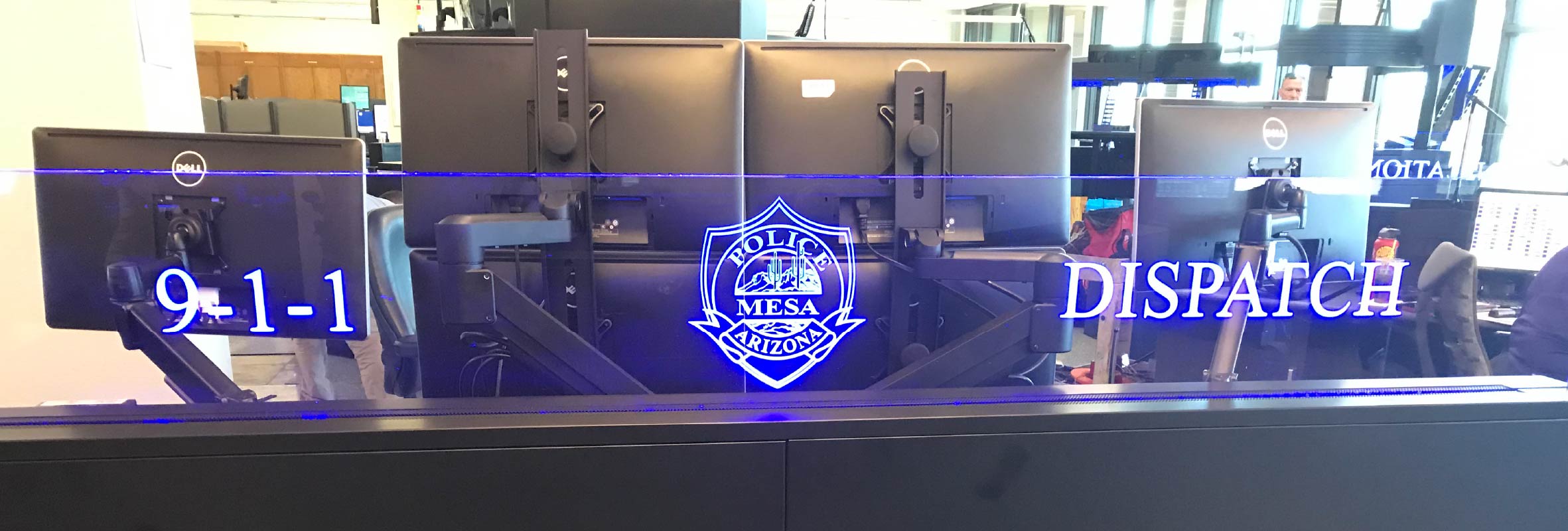
Mesa, Arizona (October 27, 2026) — Mesa Public Safety Support (MPSS) has gone live with The Monitoring Association’s (TMA) ASAP Service, allowing participating alarm-monitoring companies to send alarm notifications directly into Mesa’s computer-aided dispatch (CAD) system. The new process is expected to reduce the number of calls to the city’s nonemergency line and the time telecommunicators spend manually processing alarm notifications.
In 2025, MPSS received 8,477 alarm notifications. Based on that volume and an estimated two to eight minutes of manual handling time per call, processing all of those notifications electronically could save approximately 24 to 94 hours of staff time per month. Actual time savings will depend on how many notifications are delivered through ASAP Service.
According to Matthew Ohmer, MPSS interim communications manager, the new process is expected to provide several operational benefits:
Reduced manual processing — ASAP Service enters alarm notifications directly into the CAD system with all information generated by the alarm-monitoring company intact. This enables police, fire, and emergency medical dispatchers to act on them without requiring interaction from a 911 call-taker.
More efficient alarm notifications — Previously, alarm-monitoring companies contacted Mesa through its nonemergency line, where calls could be placed in a queue during high call volume. Electronic notifications from participating companies can now enter the dispatch system without waiting for a telecommunicator to answer a call.
Improved employee wellness — MPSS monitors factors such as time spent on calls as part of its approach to telecommunicator wellness. Reducing the number of alarm calls handled by call-takers is expected to provide additional opportunities for decompression, especially after challenging 911 calls.
The implementation also supports MPSS’s longer-term plan to transition to a universal call-taking model, Ohmer says. Currently, MPSS operates a primary emergency communications center (ECC) that handles police-oriented 911 calls and a secondary ECC that handles fire, rescue and emergency medical calls. Under the planned model, telecommunicators would be trained to handle all three call types.
"As we plan for changes to our emergency communications operations, we're looking for opportunities to reduce manual processes and use staff time more efficiently," Ohmer said. "Electronic alarm notifications are one way to help manage workload while maintaining the level of service our community expects."
MPSS implemented ASAP Service through a connection to Nlets (the International Justice and Public Safety Network) provided by Arizona’s criminal-justice message switch. ASAP Service is hosted on the Amazon Web Services GovCloud platform. ECCs that can’t access a state message switch may also connect through an interface developed by their CAD system vendor.
MPSS operates a primary ECC that serves Mesa Police Department and a secondary ECC that serves Mesa Fire and Medical Department and three additional fire districts.
Learn more about how TMA's ASAP Service is saving lives every day nationwide at asap911.org.
-30-
About The Monitoring Association
The Monitoring Association (TMA), formerly the Central Station Alarm Association (CSAA), is an internationally recognized nonprofit trade association that represents professional monitoring companies, security systems integrators, and providers of products and services to the industry. Incorporated in 1950, TMA represents its members before Congress and regulatory agencies on the local, state and federal levels, and other authorities having jurisdiction (AHJ) over the industry. Learn more online at https://tma.us/about-tma/.
About TMA’s ASAP Service
Launched in 2011 as a public-private partnership, TMA’s Automated Secure Alarm Protocol (ASAP) Service enables direct electronic dispatch of emergency calls for service from alarm companies to emergency communications centers. Increasing the accuracy and efficiency of dispatches, ASAP Service utilizes American National Standards Institute (ANSI)-accredited protocols developed cooperatively by TMA and the Association of Public-Safety Communications Officials (APCO).
CONTACT:
Julie Howerter, marketing strategist
ASAP Service
815-501-5832